When Worlds Collide
|
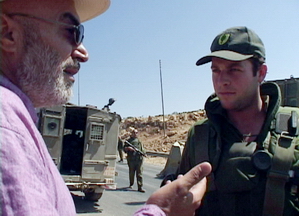
Zero Degrees of Separation Ezra (left), a gay Israeli in a relationship with a Palestinian, tries to educate Israeli soldiers about the injustices suffered by the Palestinians. (Photo courtesy of Elle Flanders) |
By Greg Marzullo
THE ISRAELI-PALESTINIAN CONFLICT seems an endless web of complications and angry finger pointing, and it’s easy to forget the humanity of the players, especially the Palestinians. Lesbian filmmaker Elle Flanders uses her documentary “Zero Degrees of Separation” to illuminate some of the darkness that surrounds the plight of everyday Palestinians under Israeli governance.
The movie is playing at the National Geographic Museum, located at 1600 M St., NW, on Saturday, Oct. 7, at 8 p.m., as part of National Geographic’s All Roads Film Festival. General admission is $8, and Flanders will be part of a question-and-answer session after her film is presented on Saturday night along with two other films about Israeli-Palestinian relations.
As her entrée into the stories of the region, Flanders follows two couples, one gay male pair and one lesbian couple, each comprised of an Israeli and a Palestinian.
“The film chose me,” says Flanders, who now lives in Toronto but grew up partially in Israel. It was her history, and that of her family, which led her to the film’s topic.
The movie is split between the couples’ stories and archival footage of Flanders’ grandparents, who were both heavily involved in the Zionist movement that led to the establishment of Israel in 1948. This dualism creates an aching sense of the misplaced idealism and stark realities involved in carving a country out of land with a Gordian history.
“[The film] was not so much to put my grandparents on a crucifix, but say this is what it is to not look, to not see,” Flanders says.
THE EXPANSION OF personal and cultural vision is part of the All Roads Film Festival’s mission. The festival runs from Oct. 5 through Oct. 8 and includes films from all over the world.
“The overall theme is to showcase works by indigenous and underrepresented minority cultures from around the world,” says Greg McGruder, the director of lectures and public programs at the museum. “Any chance you offer [people] an opportunity to look at the world through a completely different lens I say that we’re all the wiser and richer for it.”
McGruder, who is gay, screened all the film applicants for the festival, and he says “Zero Degrees” showed the Israeli-Palestinian conflict from a completely new perspective.
“There was so much passion about how these people felt about their backgrounds,” says McGruder. “You could see the tension they’re going through with their relationships under the clouds of the conflict.”
McGruder also points out that the gay elements of these people’s lives almost become secondary to the more immediate issues of violence, social oppression and a call to justice.
Flanders believes putting the gay identity on the back burner is part of the reason some U.S. gay film festivals have declined to screen the film.
“I felt it was time to challenge what’s become the status quo of queer film making,” says Flanders who adds that most gay films are only about the gay identity. “We’ve become pretty navel gazing.”
Flanders has a good sense of what’s going on in queer cinema. She ran Toronto’s gay and lesbian film festival, Inside Out, for three years and was involved with the festival in various capacities before that. Her tenure as the festival’s executive director ended in 2000.
“I felt like this was hopefully a challenge to the queer community - to say let’s broaden ourselves a little bit,” Flanders says.
THE DOCUMENTARY DOES not fit into the coming-out story, the AIDS story, the starting-a-family story or any other played-out queer cinema genre. Instead, the lesbian couple attends protests against the might of Israel’s government, and Ezra, an Israeli man, delivers supplies to Palestinian friends in the Israeli-occupied territories.
Ezra, who looks to be in his 40s or 50s, is a remarkable figure who confronts Israel’s checkpoint soldiers with the disdain of a disappointed patriarch.
“I call him my prophet in pink pajamas,” says Flanders, referring to the gauzy pink outfit Ezra wears throughout the film. “Ezra taught me an enormous amount about standing up for what you believe in.”
He berates the soldiers, but there is something hopeful behind it all, as if there’s a possibility that the young men will lay down their arms and join the resistance.
“[The film screeners] thought that Ezra was going to get his butt kicked, and he didn’t,” says McGruder.
The lesbian couple, comprised of the Palestinian Samira and the Israeli Edit, highlight the interconnectedness of all forms of persecution. Edit worked at a rape crisis center in Tel Aviv, until the organization invited then-Prime Minister Ariel Sharon to give a speech at the center.
“They understand their connection to their oppression is multi-faceted,” Flanders says.
The state of Israel itself becomes a strong character in the film. Born in the smiling faces of Flanders’ grandparents and their European friends who awkwardly pick their way through the desert, the country grows into a menacing presence that seems to strip people of their home and history. Perhaps Ezra sums it up best in the film.
“George Orwell, in his wildest dreams, could not imagine a reality such as this,” he says.
Washington Blade Online