’My life is a tango, my heart - a melodrama’
ּּBy Merav Yudilovitch
France, February 1944. Gestapo officers break into the Saint-Benoît monastery and arrest poet-painter Max Jacob. The priests’ pleas are ignored and Jacob is sent to the holding camp in Drancy where Jews, Gypsies, Communists and homosexuals were imprisoned before being sent to concentration camps. Jacob grew gravely ill in the camp and died in March of that year.
Born in 1876 to a Jewish family, Jacob would become one of the most influential artists forming the infamous bohemia of Montmartre. Close friends included Pablo Picasso, Jean Cocteau, Amedeo Modigliani and Henri Matisse. He converted to Catholicism at age 33 and battled with his homosexuality for much of his life.
|
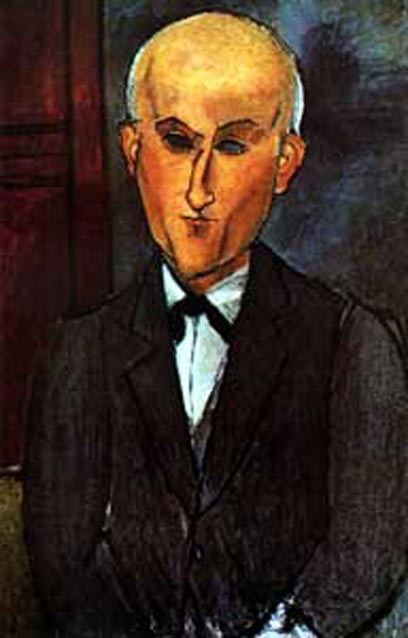
A portrait of Jacob painted by his friend Modigliani |
The forgotten tale of Max Jacob, considered one of the most important modern poets of the early 20th century, has now been adapted for the big screen by screenwriter Dan Frank and director Gabriel Aghion. The role of Jacob was given to actor Jean Claude Brialy, one of the most esteemed and prolific actors of the French "nouvelle vague," who passed away in May from cancer.
Contrary to what one might expect, ’Monsieur Max’ is not a Holocaust film. If you ask Aghion, who is visiting Israel as a guest of the Jewish Eye film festival, he will say that the movie’s main themes are solitude, abandonment and that elusive thing called art.
Upon viewing the film, it becomes clear that Aghion holds Jacob’s friends responsible for his death. First and foremost, Aghion points his finger at Picasso: "He treated Jacob like he treated his women and children. He was a man whose genius was as vast as his ego. He used Jacob and dropped him like a dirty sock."
The gap between art’s humanistic approach and the basic inhumanness and egotism of these intellectuals is very obvious.
"Humanism and art are two totally different things and this is a great example of it. Yet, we mustn’t forget that during those days France was collaborating with Nazis. Max Jacob was a gay Jew during a period where people were focused on just staying alive.
|
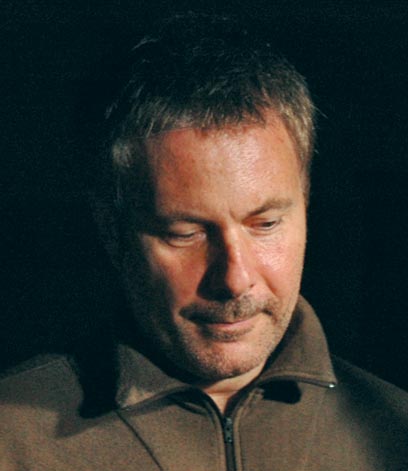
Aghion: ’I can’t explain the silence’ |
"Those days most people - from the Pope through politicians and the man on the street - were indifferent, at times this had tragic consequences. I can’t explain the silence, the apathy about the Holocaust, the Jews or this genius poet.
"All of his friends were collaborators of sorts. They could have saved him, but they didn’t. They spent the war drinking Champagne."
Aghion is the son of a Christian mother and a Jewish father who emigrated from Egypt to France. He is particularly excited about screening his film in Israel.
"Since I was very young I was always drawn to my Jewish roots. We moved to France when I was four but I grew up in exile, yearning for Egypt. I was always different, I was a stranger among Jews and Jewish among strangers. That might be the reason I choose torn people as themes for my films. I understand it well. Or, in Max Jacob’s words: "My life is a tango, my heart - a melodrama."
YNet News